.svg)


Professor McLean
Professor Emeritus of Toxicology
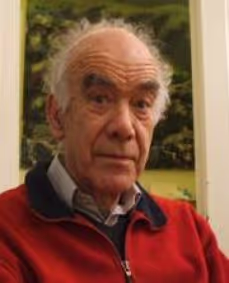
Professor Andre McLean studied medicine at Oxford and University College Hospital. While still at Oxford he did research on dietary trace elements with the Nutrition pioneer, Dr Hugh Sinclair. He continued this work while a student at UCH. After qualification and house jobs at the hospital, he went on complete a PhD, on pathology, nutrition and biochemistry.
Professor McLean then joined the Medical Research Council team working on infant malnutrition in Jamaica, doing laboratory, bedside and epidemiological work. After spending time at Chicago Medical School with Professor JD Judah, he returned to the Medical Research Council, at the Toxicology Research Unit in Carshalton. There he showed that a number of chemicals such as carbon-tetrachloride cause cell damage because metabolism by the P450 group of enzymes leads to generation of reactive metabolites, and this process was powerfully influenced by nutritional state. This was contrary to accepted views of the time. It was part of a revolution in thinking in Toxicology, bringing together biochemistry pathology and physiology to the understanding of the adverse effects of substances.
He returned to UCH as a senior lecturer, and then Professor, and set up a laboratory to study why some substances were highly toxic, and what factors alter toxicity and cell injury. This led to the successful introduction of methionine as treatment of Paracetamol overdose.Professor McLean was asked to serve on the Government Committee concerned with regulation of Pesticides, and then on Committee on Safety of Medicines. He became a member and then chair of the UCH committee on Ethics of Research with Humans. He was elected Chairman of the British Toxicology Society, and served on other committees, as well as continuing with teaching and laboratory research.

.avif)
Latest news
The Future of Cardiometabolic Research: Five Questions Shaping the Next Decade
Upcoming Event
AASLD